What this project involved
Key takeaways
Design evolution
The earliest version of the robot centered on a turret mechanism that could automatically aim discs at the target without depending on robot heading. While the concept was successful, it made the robot too heavy and reduced mobility in a game that rewarded speed and field coverage. As the strategy shifted toward more defensive play and closer-range shots, the turret became less practical. The design was first simplified and then removed entirely.
Autonomous & controls
After the drivetrain-focused redesign, the robot was prepared for state championships with stiffer odometry wheel mounting to improve autonomous position tracking. Later world-championship iterations used two odometry wheels instead of three because the center-locked drive did not require horizontal displacement tracking, letting the system stay simpler while improving reliability.
Mechanisms
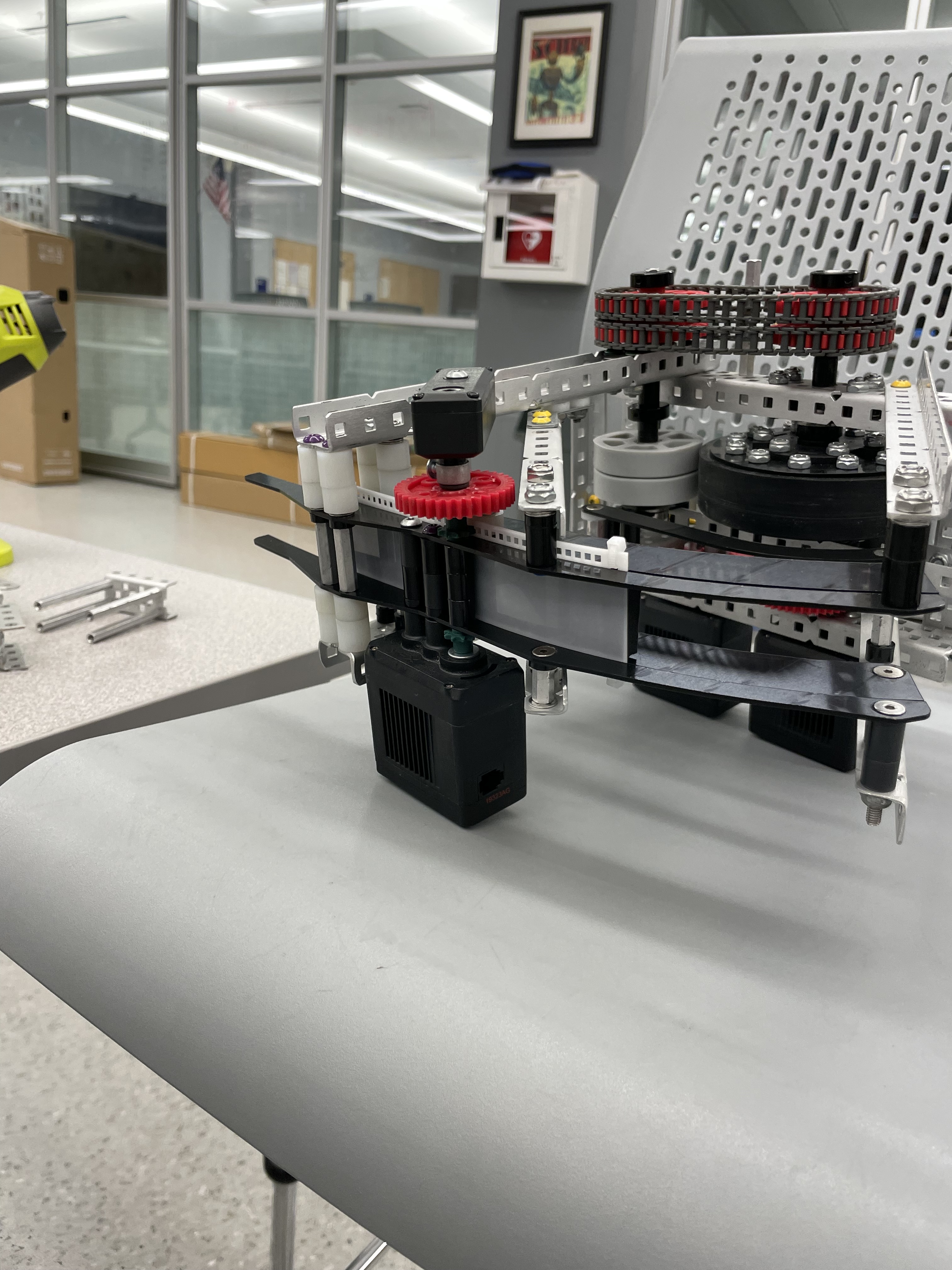
Beyond the shooter and drivetrain, the robot used an intake to move discs into the flywheel and an expansion mechanism that deployed projectiles attached to strings to touch more tiles during the endgame. A blocking expansion mechanism was also developed to interfere with other teams' expansion systems, showing a broader emphasis on both scoring and strategic control.
Outcome
The final robot performed strongly in competition. The state-level autonomous program contributed to an Excellence Award, and later world-championship performance included a 15-second autonomous routine that ranked in the top 10 in the world with an alliance partner. The team ultimately placed in the top 60 at Worlds. As a portfolio project, this is valuable because it shows early experience with system tradeoffs, iterative redesign, competition-driven engineering decisions, and mechanism development under changing constraints.